Djanovexarex
Flow Course
Flow Course
Couldn't load pickup availability
- 📄 Digital file available after purchase
- 🗂️ Long-term availability
- 🔐 Secure checkout
- 📅 Content updated in 2026
Self-paced learning overview
Problem Statement
After forms, validation, user roles, and record handling are introduced, a Django project begins to contain several connected workflows. At this stage, learners may understand each feature separately but still struggle to make the full application behave as one clear system.
Founders also need a way to review whether the project supports its intended journey from beginning to completion. Without a structured workflow map, it can be difficult to identify missing steps, unnecessary pages, unclear permissions, or actions that end without useful feedback.
Solution
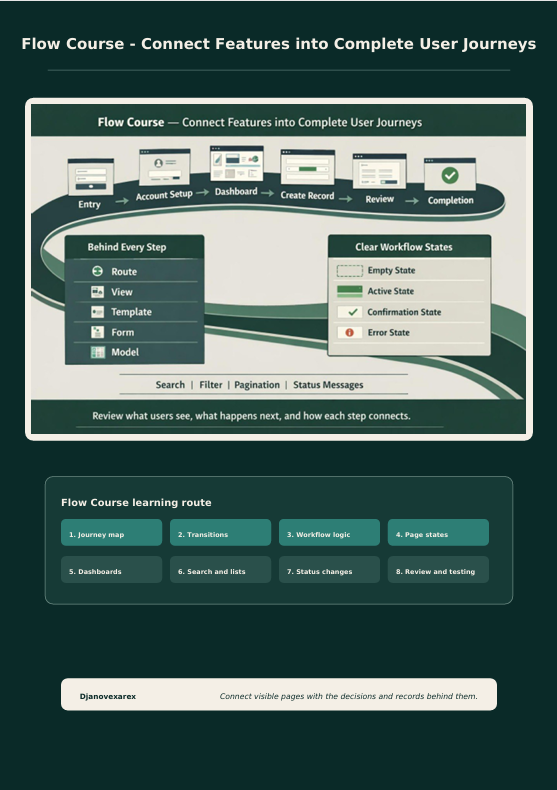
The Djanovexarex Flow Course focuses on connecting individual Django features into complete and understandable user journeys. Learners examine how routes, views, templates, forms, models, permissions, and messages work together across a sequence of actions.
By the end of the course, learners will have a more structured approach to designing connected application processes rather than treating every page as an isolated feature.
What’s Inside
The Flow Course includes modules on workflow mapping, multi-step user journeys, redirects, page-state handling, reusable view logic, dashboard planning, filtering, search behavior, pagination concepts, and clear user feedback.
Each module connects technical decisions with practical founder questions, such as what the user needs to see, what action should happen next, and what information should remain visible throughout the journey.
Who Is This For?
This tier is intended for:
- Learners continuing from the Cipher Unit
- Founders planning connected application journeys
- Developers organizing multi-step Django features
- Designers mapping page transitions and user states
- Small teams reviewing application logic
- Learners preparing for broader project refinement
What You’ll Learn
- Map a complete user journey from entry to completion
- Connect routes, views, templates, and forms across several steps
- Plan clear redirects after user actions
- Organize related views into readable workflows
- Reduce repeated logic between similar features
- Display useful status and confirmation messages
- Build structured dashboard layouts
- Add introductory filtering and search behavior
- Understand pagination for longer record lists
- Handle empty states and missing information
- Review workflows for unnecessary steps
- Identify missing permissions and unclear transitions
- Document application behavior for collaborators
- Prepare connected workflows for the Halo Guide
Guarantee
30-day money back: Customers may submit a refund request within 30 days of purchase, subject to the eligibility conditions described in the store’s published refund policy.
Risk-free: This wording refers only to the available refund request period. The course still requires time, practice, and individual technical decisions, and it does not state or imply a particular learning, project, or business outcome.
Certification
The course include a certificate of completion, giving learners a clear way to confirm their progress and showcase their achievement.
Share
How are the Djanovexarex tiers organized?
How are the Djanovexarex tiers organized?
The tiers follow a gradual learning route, beginning with introductory concepts and moving toward broader Django project planning, development, testing, deployment preparation, and long-term maintenance. Each tier builds on ideas introduced earlier while adding new technical topics and practical exercises.
Do I need previous Django experience?
Do I need previous Django experience?
The opening tiers are designed for learners with little or no previous Django experience. Later tiers introduce more detailed workflows and assume familiarity with earlier concepts. Learners may begin with the tier that matches their current knowledge, although following the full sequence provides a more connected learning experience.
What type of materials are included?
What type of materials are included?
Depending on the tier, materials may include written lessons, structured modules, planning exercises, code examples, project checklists, development tasks, review questions, and practical reference resources. Each tier focuses on applying concepts to realistic founder-led web projects.