Djanovexarex
Free Suite
Free Suite
Couldn't load pickup availability
- 📄 Digital file available after purchase
- 🗂️ Long-term availability
- 🔐 Secure checkout
- 📅 Content updated in 2026
Self-paced learning overview
Problem Statement
Many web founders begin with an idea but have difficulty understanding how that idea connects to the technical structure of a Django project. Terms such as applications, models, views, templates, routing, databases, and project settings can feel disconnected when they are introduced without a clear project context.
Solution
The Djanovexarex Free Suite introduces Django through a founder-focused learning route. Rather than beginning with large amounts of code, the course explains how the main parts of a Django project relate to a practical web idea.
The Free Suite is intended to provide a clear starting point before learners move into more detailed development work in later tiers.
What’s Inside
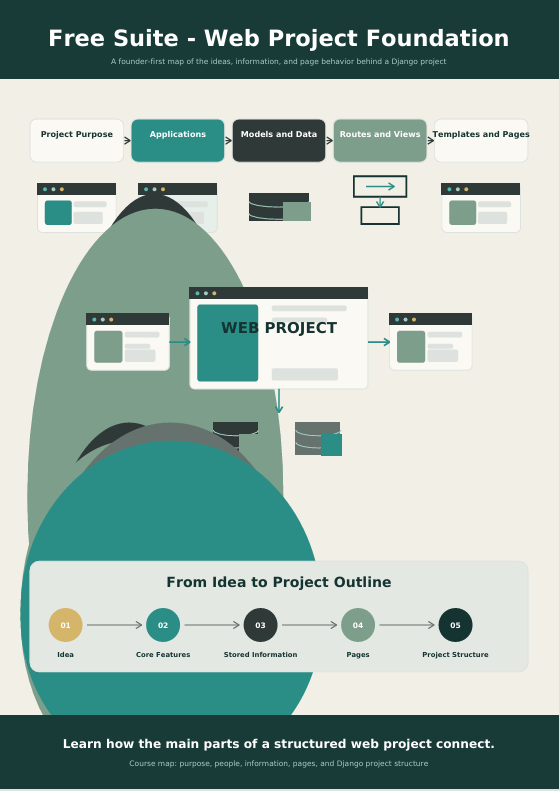
The course includes introductory lessons on Django structure, project terminology, feature planning, data organization, page flow, and development stages. Learners review a small example project and examine how its features can be divided into technical components.
Who Is This For?
This tier is suitable for:
- Founders exploring Django for the first time
- Learners considering a founder-led web project
- Small teams preparing technical project notes
- Designers and planners who want to understand Django structure
- Learners deciding whether to continue into deeper development topics
What You’ll Learn
- Explain the role of Django in a web project
- Identify the main parts of a Django project
- Distinguish between a project and an application
- Describe how pages, views, routes, and templates connect
- Outline the information a project may need to store
- Separate core features from optional ideas
- Create a simple project structure map
- Write clearer technical notes for a web concept
- Recognize the main stages of a Django development process
- Prepare for the topics introduced in the Axis Pack
Guarantee
A 30-day refund request period is available according to the store’s published refund terms. This policy applies to purchase eligibility and does not state or imply a specific learning, technical, or business outcome. Customers should review the full refund conditions before completing a purchase.
Certification
The course include a certificate of completion, giving learners a clear way to confirm their progress and showcase their achievement.
Share
How are the Djanovexarex tiers organized?
How are the Djanovexarex tiers organized?
The tiers follow a gradual learning route, beginning with introductory concepts and moving toward broader Django project planning, development, testing, deployment preparation, and long-term maintenance. Each tier builds on ideas introduced earlier while adding new technical topics and practical exercises.
Do I need previous Django experience?
Do I need previous Django experience?
The opening tiers are designed for learners with little or no previous Django experience. Later tiers introduce more detailed workflows and assume familiarity with earlier concepts. Learners may begin with the tier that matches their current knowledge, although following the full sequence provides a more connected learning experience.
What type of materials are included?
What type of materials are included?
Depending on the tier, materials may include written lessons, structured modules, planning exercises, code examples, project checklists, development tasks, review questions, and practical reference resources. Each tier focuses on applying concepts to realistic founder-led web projects.