Djanovexarex
Vertex Map
Vertex Map
Couldn't load pickup availability
- 📄 Digital file available after purchase
- 🗂️ Long-term availability
- 🔐 Secure checkout
- 📅 Content updated in 2026
Self-paced learning overview
Problem Statement
As a Django project becomes larger, founders and learners need a clearer view of how features, data, user roles, and technical components connect across the full application. Individual modules may work correctly, yet the overall project can still become difficult to understand when relationships are not documented.
Founders may also find it difficult to explain the application structure to collaborators. A list of features rarely shows how information enters the project, where it is stored, who can change it, and which pages display it.
Solution
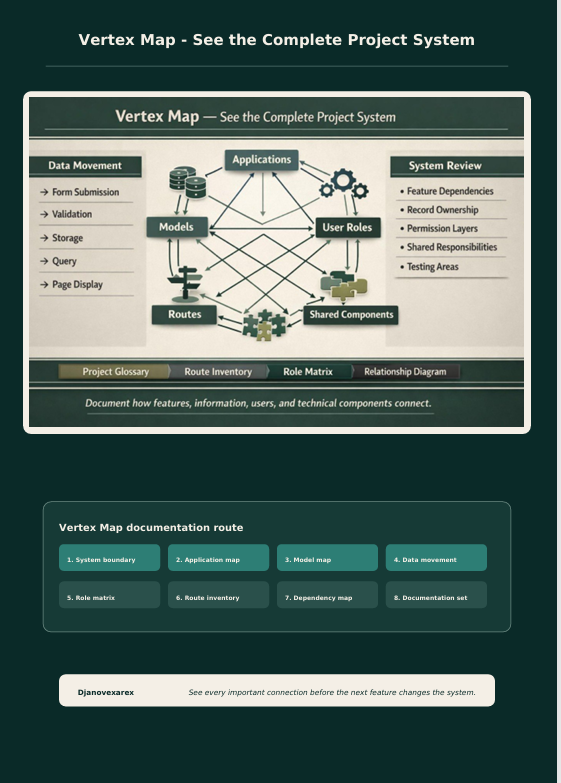
The Djanovexarex Vertex Map provides a structured method for documenting a Django application as a connected system. Learners create visual and written maps covering applications, models, relationships, user roles, workflows, routes, and supporting components.
This tier supports clearer planning before more complex features are introduced. It also helps learners prepare project documentation that can be reviewed by developers, designers, and other collaborators.
What’s Inside
The Vertex Map includes modules on application architecture, model relationships, data-flow mapping, permission layers, route inventories, feature dependencies, and system documentation.
The materials also contain a documentation worksheet, project glossary template, feature connection checklist, technical review questions, and guided mapping exercises.
Who Is This For?
This tier is intended for:
- Learners continuing from the Halo Guide
- Founders documenting a growing Django project
- Developers reviewing relationships between features
- Small teams preparing shared technical references
- Designers studying how information moves between pages
- Project planners organizing future development stages
What You’ll Learn
- Create a complete overview of a Django project
- Map relationships between applications and features
- Document model connections and record ownership
- Trace information from submission to storage and display
- Create a user-role and permission matrix
- Build a route and page inventory
- Identify dependencies between workflows
- Recognize duplicated responsibilities across applications
- Document shared components and supporting functions
- Explain technical structure in clearer language
- Create a project glossary for collaborators
- Review architecture before adding new features
- Identify areas that require further testing
- Prepare system documentation for the Luma Pathway
Guarantee
30-day money back: Customers may submit a refund request within 30 days of purchase, subject to the eligibility conditions described in the store’s published refund policy.
Risk-free: This phrase refers only to the available refund request period. The course requires study, practice, and individual technical decisions. It does not state or imply a particular learning, project, employment, or business outcome.
Certification
The course include a certificate of completion, giving learners a clear way to confirm their progress and showcase their achievement.
Share
How are the Djanovexarex tiers organized?
How are the Djanovexarex tiers organized?
The tiers follow a gradual learning route, beginning with introductory concepts and moving toward broader Django project planning, development, testing, deployment preparation, and long-term maintenance. Each tier builds on ideas introduced earlier while adding new technical topics and practical exercises.
Do I need previous Django experience?
Do I need previous Django experience?
The opening tiers are designed for learners with little or no previous Django experience. Later tiers introduce more detailed workflows and assume familiarity with earlier concepts. Learners may begin with the tier that matches their current knowledge, although following the full sequence provides a more connected learning experience.
What type of materials are included?
What type of materials are included?
Depending on the tier, materials may include written lessons, structured modules, planning exercises, code examples, project checklists, development tasks, review questions, and practical reference resources. Each tier focuses on applying concepts to realistic founder-led web projects.